
MAS consults on targeted updates to corporate governance requirements for banks, insurers, and designated financial holding companies
19 October 2026
The Monetary Authority of Singapore (“MAS”) has published a consultation paper seeking feedback on targeted updates to the corporate governance regulations applicable to banks, insurers, and their designated financial holding companies, as part of MAS’ regular review of regulatory standards to keep them current and effective. The proposed changes build on an established and well-functioning corporate governance framework by strengthening safeguards in specific areas where risks and practices have evolved while streamlining requirements for financial institutions (“FIs”) with less impact on customers and the financial system.
The consultation seeks views on MAS’ proposals to amend five instruments, namely, the:
- Banking (Corporate Governance) Regulations 2005 (“Banking CG Regulations”);
- Banking Regulations;
- Insurance (Corporate Governance) Regulations 2013 (“Insurance CG Regulations”);
- Financial Holding Companies (Corporate Governance of Designated Financial Holding Companies with Bank Subsidiary) Regulations 2022 (“DFHC (Bank) CG Regulations”); and
- Financial Holding Companies (Corporate Governance of Designated Financial Holding Companies with Licensed Insurer Subsidiary) Regulations 2022 (“DFHC (Licensed Insurer) CG Regulations”).
The consultation commenced on 30 September 2026 and closes on 9 December 2026.
Director independence
MAS proposes to refine the criteria for determining whether directors are independent from management, business relationships, and substantial shareholders.
Criteria for determining independence from management and business relationships
The existing Banking CG Regulations, Insurance CG Regulations, DFHC (Bank) CG Regulations, and DFHC (Licensed Insurer) CG Regulations (collectively, “CG Regulations”) set out the circumstances under which a director is considered independent from management and business relationships with a locally incorporated FI. MAS proposes to widen the existing scope, which covers the FI and its subsidiaries, to include related corporations. Related corporations refer to the locally incorporated FI’s parent company, subsidiaries, and other subsidiaries of the locally incorporated FI’s parent company (i.e. sister companies).
Criteria for assessing independence from management relationships
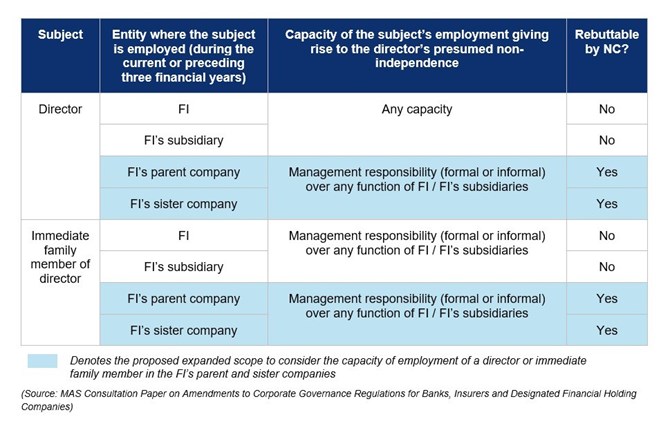
MAS proposes to widen the criteria in the CG Regulations for assessing a director’s independence from management relationships by considering whether a director is employed by the locally incorporated FI’s related corporations and the extent of that person’s responsibilities over the FI’s operations. A director employed by the FI’s parent or sister companies will be presumed non-independent only if he or she has management responsibility over the functions of the FI or its subsidiaries. MAS proposes to allow the Nominating Committee (“NC”) to rebut the presumption of non-independence for directors within this additional scope of management relationships. MAS proposes additional measures in respect of the management relationships of immediate family members employed with the FI’s parent or sister companies. MAS has summarised the proposed scope of considerations for independence from management relationships as follows:
Independence from business relationships
MAS proposes to widen the criteria in the CG Regulations for assessing a director’s independence from business relationships to include dealings with the FI’s related corporations, beyond the existing scope of the FI and its subsidiaries. Additionally, MAS proposes to also consider the business relationships of the director’s immediate family members.
Further, MAS proposes to narrow the scope of business relationships to cover only significant payments that the locally incorporated FI or any of its related corporations has made to or received from a director-related entity. The determination of what constitutes a “significant payment” should be made by the NC.
Independence from substantial shareholder
MAS proposes to revise the conditions for allowing a director of a locally incorporated FI who is “connected to” the FI’s locally incorporated parent entity, but has no relationship with any other substantial shareholder of the parent entity, to be regarded as independent from a substantial shareholder of the FI. The conditions are:
- the locally incorporated FI is a wholly owned and immediate subsidiary of its locally incorporated parent bank, parent insurer, or designated financial holding company. The FI and its parent entity need not operate in the same financial sector (e.g. the concession may apply where a locally incorporated bank owns a locally incorporated insurer); or
- the locally incorporated FI is the sole, wholly owned, and immediate subsidiary of a locally incorporated FHC that:
- is not designated under the Financial Holding Companies Act 2013; and
- does not carry on any business other than holding the locally incorporated FI.
In addition, MAS proposes that a director of a locally incorporated FI who is also a director or employee of an affiliate of a substantial shareholder be deemed as non-independent from the substantial shareholder. The NC may continue to make a determination to consider a non-executive director of a substantial shareholder’s affiliate as independent from the substantial shareholder, but such determination must be to the satisfaction of MAS.
Aggregate nine-year limit on director’s independence
MAS seeks comments on its proposal for a director who has served on the board of directors (“Board”) for an aggregate period of nine years or longer to be considered non-independent, and for this to be a hard limit.
MAS also proposes that, where the CG Regulations only require directors to be independent from management and business relationships, the directors must also not have served on the Board for nine years or more. This applies to the composition requirements for both Board and mandatory board committees, and such directors will be deemed largely independent.
Board and board committee requirements
MAS proposes to adopt a tiered approach to the composition requirements for Boards and board committees. Certain baseline standards will apply to all FIs, while systemically important FIs will generally be subject to more stringent requirements. The proposals include an increase in the minimum Board size and a requirement for a majority of independent directors for domestic systemically important banks and insurers as well as full banks.
MAS also proposes various measures to strengthen Board and committee independence and governance, including:
- requiring all members of the Remuneration Committee to be non-executive directors;
- introducing restrictions on concurrent positions; and
- mandating the set-up of a Risk Management Committee for all locally incorporated banks, domestic systemically important insurers, and Tier 1 insurers.
Prior approval for key appointments
MAS proposes to require prior approval for additional key appointments, such as chairperson of the NC of locally incorporated banks and insurers, and chief information officer of domestic systemically important banks.
MAS also proposes to remove the requirement for prior approval of certain Board and senior management appointments for FIs assessed to have less retail reach or lower systemic importance.
Reference materials
The following materials are available on the MAS website www.mas.gov.sg: