
Building supply chain resilience through human rights and environmental due diligence
16 December 2025
In the wake of increasing regulatory uncertainty, climate volatility, and geopolitical tensions, resilience has become as important as efficiency in global value chains. Supply chain visibility and due diligence not only help uncover sustainability risks, but also unlock new opportunities for growth, diversification, and cost optimisation. Conversely, gaps in identifying or managing human rights and environmental impacts in the supply chain can expose companies to financial, operational, and reputational harm.
Across Asia, the legal landscape is beginning to shift towards mandatory human rights and environmental due diligence (HREDD). Recent legislative moves in South Korea and Thailand signal increased scrutiny of supply chains. South Korea’s reintroduced Act on the Protection of Human Rights and the Environment for Sustainable Business Management (June 2025) and Thailand’s draft Act on the Promotion of Business Conduct (July 2025) both seek to embed greater corporate transparency and accountability, bringing business practices in line with internationally recognised sustainability and human rights principles.
Beyond reporting obligations, domestic and foreign enterprises with significant supply chain footprints will need to actively mitigate identified adverse impacts across their business operations and value chains. Even where companies are not directly in-scope, they can expect requirements to cascade through the value chain to direct and indirect business partners.
Practical starting point for companies
Companies should begin with a comprehensive mapping of their entire supply chain, including subsidiaries, contractors, and business partners. This also involves identifying material risks across different geographies and industry segments, understanding how impacts may occur, and highlighting where deeper scrutiny is required. Risk exposure will vary widely depending on sector, country, and risk type (e.g. labour practices, environmental impacts, sanctions exposure). Based on this assessment, companies can categorise suppliers by risk levels, and allocate resources and tailor actions accordingly, for example, conducting on-site audits, examining subcontractors for higher-risk suppliers, and adopting lighter-touch periodic reviews for lower-risk ones.
Building a resilient and responsible supply chain demands a proactive approach. For many companies, establishing a structured due diligence framework is not a regulatory obligation but a strategic necessity.
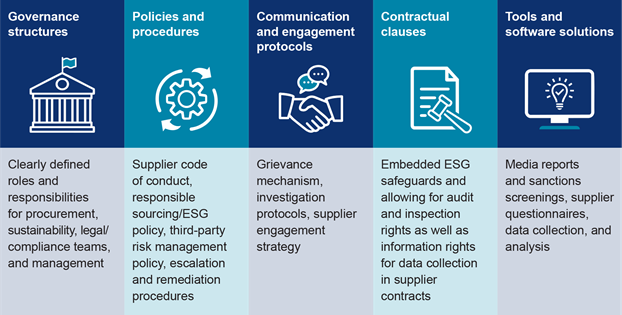
The table below sets out the core elements of a robust supply chain framework.
Sustainability Legal Catalyst Programme
Allen & Gledhill is pleased to partner with Enterprise Singapore (“EnterpriseSG”) under the Sustainability Legal Catalyst Programme (“SLCP”). SLCP is an initiative designed to help businesses navigate the evolving legal and regulatory sustainability landscape. As sustainability-related regulations and disclosure requirements continue to grow, businesses must proactively manage legal risks while seizing opportunities in the sustainable economy.
Through this programme, Enterprise Singapore will defray up to 50% of the legal fees for eligible services provided to all Singapore incorporated entities with at least 30% local shareholding during the qualifying period of 1 February 2025 to 31 January 2027, with the incentive capped at S$90,000 per company. As a legal partner in this programme, we are committed to supporting Singapore enterprises by providing legal and regulatory advice across a wide spectrum of sustainability-related matters.