Knowledge Highlights 9 February 2026

On 27 July 2026, the Interim Sustainability Standards Committee (“Interim SSC”) of the Accounting and Corporate Regulatory Authority (“ACRA”) published the draft Singapore Sustainability Disclosure Standards (“SDS”) for public consultation. The draft SDS set out the information companies would be required to disclose on how they manage climate-related risks and opportunities. The consultation closes on 25 October 2026.
ACRA is also preparing the necessary legislation to implement Singapore’s climate reporting and assurance requirements. When the law is passed, ACRA will formally constitute the Sustainability Standards Committee, which will have the power to issue the final SDS.
Application of SDS
The SDS is expected to apply as follows:
This follows the current phased approach for mandatory climate reporting requirements for Singapore-incorporated companies, starting with listed companies (tiered by market capitalisation), followed by large non-listed companies, summarised as follows:
|
Mandatory |
Timeline |
|||
|
Listed companies |
Large |
|||
|
Straits Times Index (“STI”) constituents |
Non-STI constituent listed companies ≥S$1B market cap |
Non-STI constituent listed companies <S$1B market cap |
||
|
Scope 1 and Scope 2 greenhouse gas (“GHG”) emissions |
Financial year beginning on or after (“FY”) 2025 |
FY2030 |
||
|
Other ISSB-based climate-related disclosures |
FY2025 |
FY2028 |
FY2030 |
FY2030 |
|
Scope 3 GHG emissions |
FY2026 |
Voluntary |
Voluntary |
Voluntary |
|
External limited assurance for Scope 1 and Scope 2 GHG emissions |
FY2029 |
FY2032 |
||
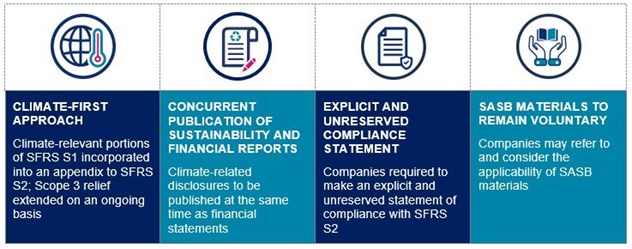
The draft SDS are closely aligned with the International Sustainability Standards Board (“ISSB”) Standards, with amendments proposed to reflect Singapore’s specific regulatory approach and the phased implementation of sustainability reporting requirements. The draft SDS comprise two standards, with only Singapore Financial Reporting Standards (“SFRS”) S2 being mandatory given Singapore’s climate-first approach:
Although draft SFRS S2 sets out the full suite of climate-related disclosure requirements, companies will only be required to comply with the requirements that are mandatory at each stage of Singapore’s implementation roadmap.
In the interim, prior to the issuance of the SDS, listed companies will continue to report in accordance with their existing obligations under the Listing Rules of the Singapore Exchange (“SGX”), including the requirement to apply the ISSB Standards. Once issued, companies will either transition to the SDS from their existing reporting obligations or adopt it directly.
Key amendments proposed in draft SDS
Greater connectivity between sustainability-related and financial information
The draft SDS propose requiring companies to publish their climate-related disclosures at the same time as their financial statements. This supports the objective of enabling users to assess the connections between climate-related risks and opportunities and their financial effects, and to consider sustainability-related financial information alongside the financial statements.
Greater accountability
The draft SDS will require companies to make an explicit and unreserved statement of compliance with SFRS S2. ACRA has stated that this holds entities accountable, provides users with a clear signal of compliance, and establishes a basis for assurance.
The requirement raises considerations regarding the legal effect of making a statement of compliance. Under existing financial reporting practice, companies are required to make explicit and unreserved statements of compliance with Singapore Financial Reporting Standards (International) (“SFRS(I)”) and, where applicable, IFRS Accounting Standards in their financial statements. Rule 709A of the SGX Mainboard Rules and Catalist Rules also requires annual financial statements to be “prepared in accordance with” the applicable financial reporting framework, including SFRS(I), IFRS, or US Generally Accepted Accounting Principles.
There is currently no prescribed wording for compliance with the SDS or requirement under the SGX Listing Rules for such a statement in relation to sustainability reporting. SGX has indicated that it intends to review whether a statement of compliance should be required, with a view to aligning the SGX Listing Rules with the final SDS. While the final SDS may not prescribe specific wording, companies will need to ensure that any statement of compliance meets the substantive requirement to be “explicit and unreserved”, supported by robust processes, controls, and documentation.
The draft SDS also provide specific reliefs from disclosure in certain circumstances, including where disclosure is prohibited by law or regulation or where information relating to a climate-related opportunity is commercially sensitive. The statement of compliance should be read together with the requirements and permitted reliefs under the SDS. Where an entity relies on a specific relief, it should ensure that the circumstances supporting the reliance are appropriately considered and documented.
The regulatory consequences of non-compliance with the SDS remain to be determined under the final framework. ACRA’s approach to non-compliance with prescribed accounting standards nevertheless illustrates the broader regulatory emphasis on compliance with mandatory reporting requirements. Depending on the severity of the non-compliance, this may include issuing advisory letters, requiring remediation such as the revision and refiling of financial statements, issuing warnings or imposing composition sums, and/or prosecuting the directors.
|
Key takeaways for reporting entities The draft SDS largely confirm the direction already set out in Singapore’s sustainability reporting roadmap, but also provide further insight into the regulatory expectations underpinning Singapore’s sustainability reporting regime. In particular, the requirement for concurrent publication and an explicit and unreserved statement of compliance with SFRS S2 may warrant particular attention around the quality, substantiation, governance, and accountability of sustainability-related financial disclosures. Companies may wish to assess whether their existing reporting and governance arrangements provide a sufficiently robust basis for meeting the SFRS S2 requirements and supporting any statement of compliance. This may include reviewing the legal and compliance basis for the disclosures, documenting significant judgements and reliance on permitted reliefs, and identifying potential gaps before the statement of compliance is made. The final SDS, together with any consequential amendments to the SGX Listing Rules, should be monitored as the framework is finalised. |
Background
ACRA and SGX established the Sustainability Reporting Advisory Committee in 2022 to develop a roadmap for mandatory climate reporting and assurance, with requirements to be implemented in phases. The implementation timelines were adjusted in August 2025 to give companies more time to build capabilities for climate reporting.
ACRA established the Interim SSC in May 2025 to develop Singapore’s sustainability disclosure and assurance standards in line with international standards.
Reference materials
The following materials are available on the ACRA website www.acra.gov.sg:
Sustainability Legal Catalyst Programme
Allen and Gledhill is pleased to partner with Enterprise Singapore (“EnterpriseSG”) under the Sustainability Legal Catalyst Programme (“SLCP”). SLCP is an initiative designed to help businesses navigate the evolving legal and regulatory sustainability landscape. As sustainability-related regulations and disclosure requirements continue to grow, businesses must proactively manage legal risks while seizing opportunities in the sustainable economy.
Through this programme, EnterpriseSG will defray up to 50% of the legal fees for eligible services provided to all Singapore incorporated entities with at least 30% local shareholding eligible businesses during the qualifying period of 1 February 2025 to 31 January 2027, with the incentive capped at S$90,000 per company. As a legal partner in this programme, we are committed to supporting Singapore enterprises by providing legal and regulatory advice across a wide spectrum of sustainability-related matters.